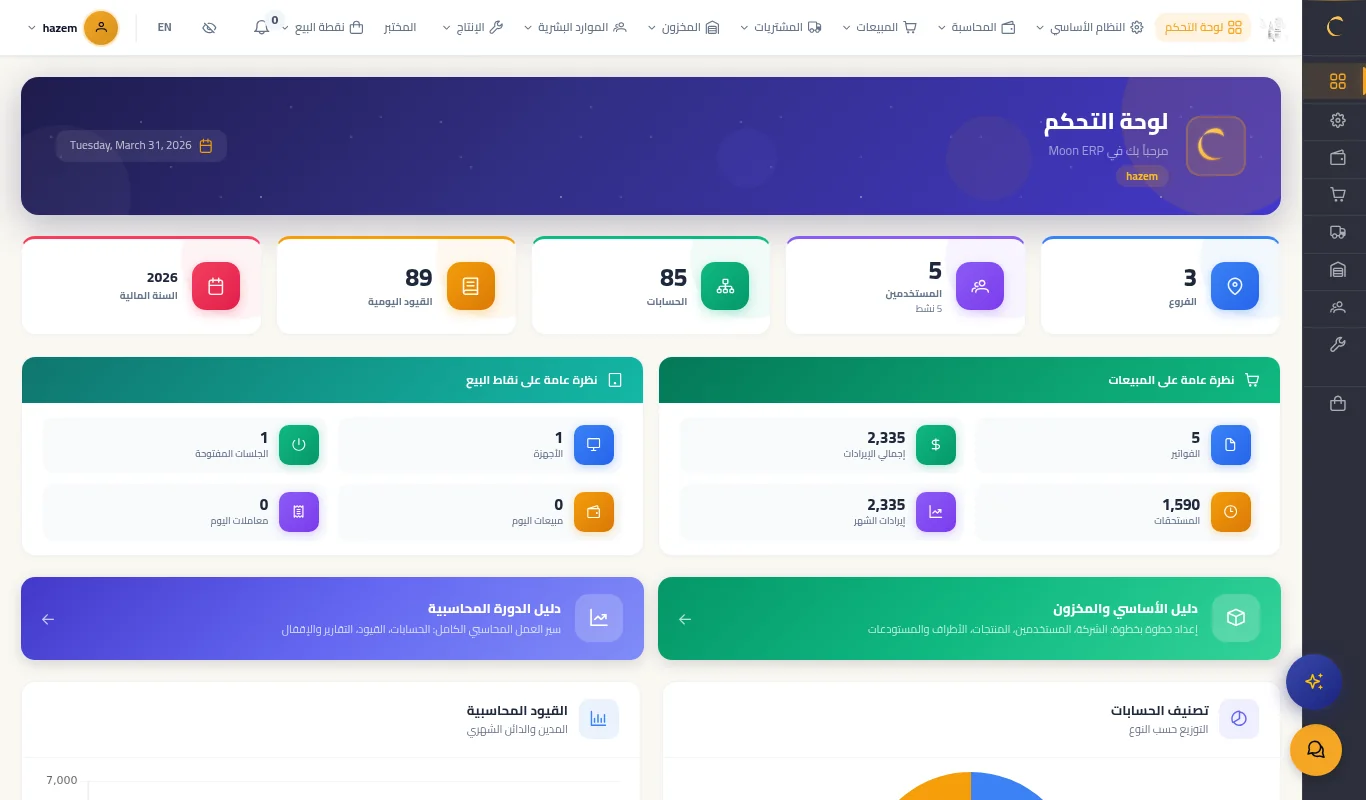
01Chart of Accounts
Organizes financial accounts in a clear tree for posting and aggregation.
- Create parent and child accounts across assets, liabilities, equity, revenue, and expenses.
- View the chart as a tree or list and monitor each account balance.
- Prevent posting to header, frozen, or inactive accounts.
Read the docs02Fiscal Years and Periods
Controls accounting calendars and sequential period opening and closing.
- Create a fiscal year and automatically generate twelve monthly periods.
- Pause operational entries while allowing adjustments during soft close.
- Close periods sequentially, then close the year when all are complete.
Read the docs03Journal Entries
Records balanced financial transactions through review, posting, and reversal.
- Record two or more lines with equal total debits and credits.
- Attach currencies, cost centers, and descriptions to individual lines when needed.
- Approve and post entries, or reverse a posted entry with a counter-entry.
Read the docs04Currencies and Exchange Rates
Supports multi-currency recording, conversion, and revaluation in the base currency.
- Set one base currency and manage active currencies and display precision.
- Maintain dated exchange rates and use the latest available rate on the entry date.
- Preview revaluation differences, then post unrealized currency gains or losses.
Read the docs05Cost Centers
Tracks cost and revenue by department or project in a hierarchy.
- Build a multi-level tree for departments, projects, and business units.
- Optionally tag journal lines with an active cost center.
- Roll child-center results into parent-center reports.
Read the docs06Tax Rates
Defines VAT and withholding rates and links them to financial accounts.
- Manage active tax rates and choose one default rate.
- Calculate inclusive or exclusive tax, including compound and multi-line cases.
- Post tax amounts to the proper ledger account and expose them in compliance reports.
Read the docs07Bank Accounts
Registers company bank accounts and links them to currency, ledger, and branches.
- Store bank details and link each bank account to a distinct detail ledger account.
- Set the account currency and assign availability to one or more branches.
- Use active accounts for checks, transfers, and bank reconciliation.
Read the docs08Issued and Received Checks
Tracks checks from creation through cashing, collection, or return.
- Manage issued checks through delivery, cashing, or cancellation.
- Manage received checks from receipt to collection or return.
- Automatically create the appropriate entries as a check changes state.
Read the docs09Petty Cash
Manages small-expense funds, custodians, and balance movements.
- Create a fund linked to a ledger account, custodian, and maximum amount.
- Record replenishments and payments with balance derived from posted activity.
- Prevent exceeding the fund ceiling or paying more than the available balance.
Read the docs10Account Transfers
Moves funds between cash and bank accounts with an immediate balanced entry.
- Transfer between two different detail accounts for cash and cash equivalents.
- Capture the amount, date, currency, reference, and description.
- Post a debit to the destination and credit to the source, with no later editing.
Read the docs11Entry Templates and Recurring Entries
Streamlines repetitive entries with balanced templates and automated schedules.
- Create a balanced reusable template with accounts, amounts, and cost centers.
- Schedule execution daily, weekly, monthly, quarterly, or yearly.
- Freeze a template snapshot, backfill missed cycles, and track executions.
Read the docs12Opening Balances
Carries starting account balances and outstanding invoices into a new year.
- Enter account balances and assign a partner or cost center when needed.
- Add outstanding customer and supplier invoices and review totals by classification.
- Confirm a balanced opening set to create the entry, then lock it against changes.
Read the docs13Budgets
Plans annual and monthly targets and compares them with actual results.
- Distribute a budget across accounts, months, and cost centers.
- Manage estimated, revised, or approved budgets through an approval flow.
- Compare planned amounts with posted actuals and calculate variance.
Read the docs14Cost Allocation
Distributes shared costs from a source center to beneficiary centers.
- Define allocation rules by percentage, headcount, area, or other drivers.
- Simulate the allocation and preview its effect before creating a real movement.
- Execute an entry that relieves the source center and charges target centers.
Read the docs15Fixed Assets
Tracks an asset from registration and depreciation through disposal or sale.
- Categorize assets with default accounts, depreciation method, and useful life.
- Run periodic straight-line, declining-balance, or accelerated depreciation.
- Record disposal or sale and automatically calculate the gain or loss.
Read the docs16Bank Reconciliation
Matches bank statements to the books and resolves differences through approval.
- Import statement movements and validate opening and closing balance integrity.
- Match by amount and date automatically or manually, leaving ambiguous cases for review.
- Create a missing entry when needed, then complete and approve the reconciliation report.
Read the docs17Accounts Receivable and Payable
Shows customer and supplier balances directly from the general ledger.
- Aggregate customer and supplier balances from posted partner-linked entries.
- Produce a detailed partner statement with opening and running balances.
- Net balances for a party that is both customer and supplier within the smaller balance.
Read the docs18Year-End Closing
Clears revenue and expense accounts and transfers the result to retained earnings.
- Check year readiness across periods, entries, and opening balances.
- Create revenue and expense closing entries and transfer the net result.
- Exceptionally reopen the year and reverse its closing entries.
Read the docs19Financial Reports
Turns posted entries into filterable financial statements and control analyses.
- Produce income statement, balance sheet, cash flow, and trial balance reports.
- Analyze aging, partner statements, cost centers, and budgets.
- Review voucher, tax, ledger, and account-balance reports without changing data.
Read the docs