Accounting
Chart of accounts, journal entries, banks and financial reports.
A plain guide to ERP systems
An ERP system is one program that runs a company's different departments on a shared database, instead of a separate program for each. This guide explains what ERP means and includes, how it differs from accounting software, and when your company needs one.
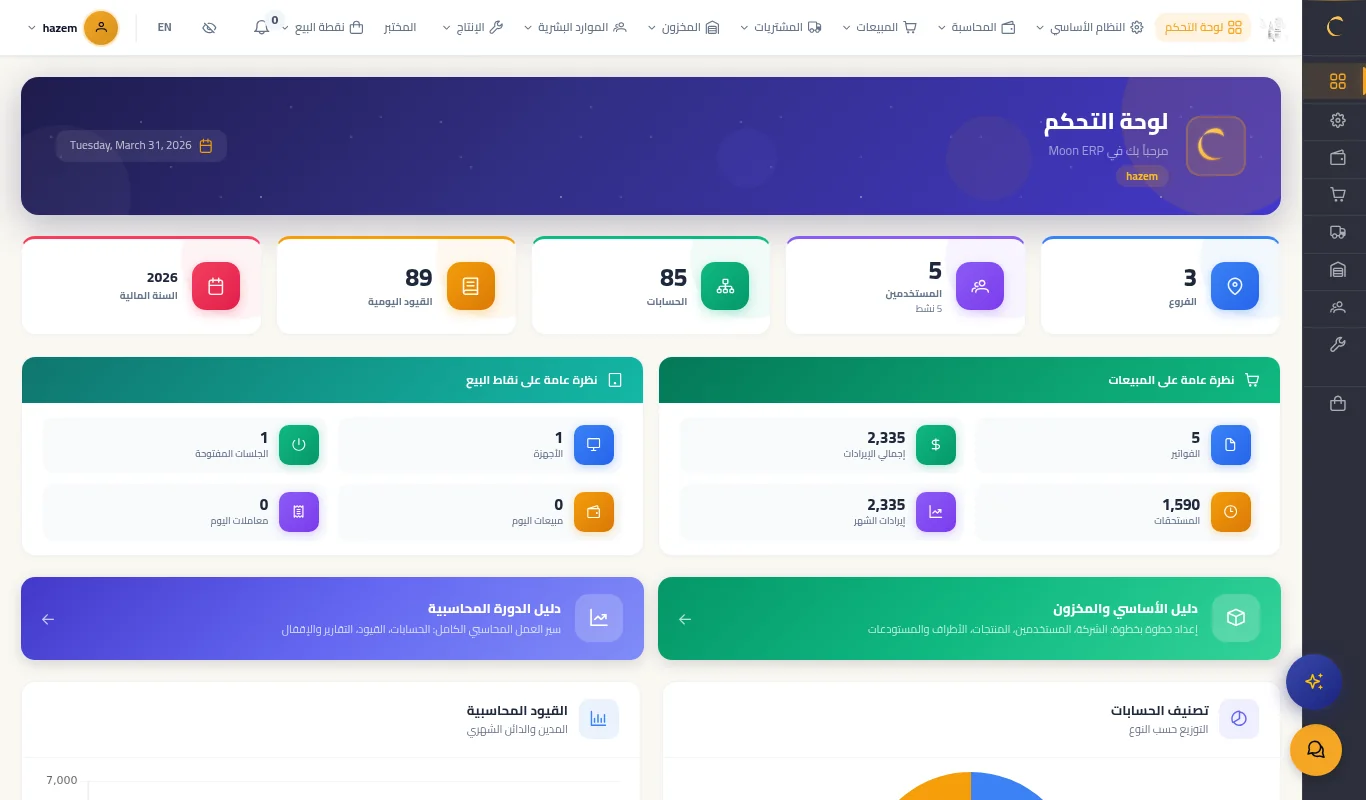
ERP stands for Enterprise Resource Planning. The idea is that each transaction is recorded once and then used by every department that needs it: the sales order reaches the warehouse and the invoice reaches the accounts, with no re-entry.
An ERP system is made of modules, and a company picks the ones that fit its business. The most common are:
Chart of accounts, journal entries, banks and financial reports.
Item balances, movements, costing and stock counts.
Quotations, orders, invoices, collection and payment.
Employee files, attendance, leave and payroll.
Bills of materials, production orders and product cost, for manufacturers.
Over-the-counter selling in shops and following up customer requests.
Stand-alone accounting software serves the accounts department: it records entries and produces financial statements. Stock, sales and payroll data come from other files or programs, and the accountant re-enters them.
In an ERP system accounting is one module within a larger system, and the entry arises from the transaction itself. The choice depends on company size: a small business that only needs books may be fine with accounting software, while a company with stock, branches and a sales team benefits from the link.
There is no fixed size at which a company needs ERP, but some signs come up again and again:
The invoice is written in one program, then copied to the stock file, then to the accounts.
Book stock differs from the count, or a customer's balance differs between sales and accounts.
Finding out the month's profit takes days of gathering files.
It is hard to see the whole picture when each branch works from its own files.
Moon ERP is an Arabic ERP program that runs in the browser with an Arabic and English interface. It includes accounting, inventory, sales, purchases, point of sale, HR, production and e-invoicing modules, with multiple branches and detailed permissions for each user.
It is developed by GT4 IT Solutions, in software since 2005 and based in Mansoura, and is used by hundreds of clients in Egypt and the Arab countries, with training and support in Arabic. A free trial company opens in about a minute with no payment card.
ERP stands for Enterprise Resource Planning: one system that runs accounting, inventory, sales and the other departments.
It can be, if the company has stock, more than one branch or several departments exchanging data. Modular systems let a company start with only what it needs.
Decide which departments you want to connect, check that the system covers them and works in your language, then try it on real data and ask about training and support.
Pricing depends on the modules you need and the number of users; the sales team replies on WhatsApp with a quote.
Six practical criteria and common mistakes before you buy.
Journals, banks, cheques, fixed assets and live financial reports.
Receipts, issues, transfers, counts and costing tied to the accounts.
An Arabic ERP with accounting, inventory, sales and training in Arabic.
A free trial that opens in a minute. No payment card needed.
Start the free trial
Want to see it on your own business?